

Rising Treasury Bond Yields: What Investors Should Know

To understand what rising Treasury bond yields mean for the economy and the stock market, imagine you are lifting weights at the gym.
You progress to ever-heavier plates, trying to lift each a total of ten times before moving on. Finally, you get to the real monsters: weights so heavy, you really have to strain. Still, you’re plenty strong, so you lift them once. Three times. Five times. Seven.
And then you notice it: The wobble in your arms. Each rep is getting harder. Your form is shot. Suddenly you realize that while you may get to ten, it’s possible your strength will give out. You could pull a muscle or even drop the bar on yourself. It’s a risky situation.
This is our analogy for understanding bond yields and their relationship to both the economy and the stock market. An economy can be strong and still feel the strain when the weight of borrowing costs gets heavier.
The bond market is an important topic. Most of the time, bonds, specifically U.S. Treasury securities, hum along in the background, quietly being the backbone of our financial system. But there are times when they demand the spotlight.²
This is one of those times.
Treasury Bond Yields: Frequently Asked Questions
Why are bond yields making headlines?
Treasury yields have been rising, bringing renewed attention to the cost of borrowing. The yield on 10-year Treasury notes reached about 5% on September 15, 2026.¹ Thirty-year Treasury yields have also returned to levels last seen in 2007.⁴
Those changes matter well beyond the bond market. To understand why, it helps to start with what a bond actually is.
What are bond yields, and why do they matter?
When you buy a bond, you are essentially lending money to the bond’s issuer. In return, the issuer promises to pay you interest and then repay the original amount after a predetermined length of time.
A bond’s yield is a way of measuring its return. One measure, called current yield, is calculated by dividing the bond’s annual interest payment by its market price.¹⁵
For example, imagine an investor, whom we’ll call Alfred, buys a bond with a 10% interest rate for $1,000. The bond pays $100 in annual interest, so its current yield would be 10%, too.
Now imagine that Alfred sells that bond to Ethyl a year later, but for $75 more. Since Ethyl pays $1,075 for the same $100 annual interest payment, her current yield would be about 9.3%. She’s paying more for the same amount of interest.
However, if Alfred sold the bond for less than he originally paid, say $975, Ethyl’s current yield would rise to about 10.26%.
These examples illustrate an important relationship: Bond prices and yields move in opposite directions. If a bond’s price goes up, its yield goes down. If the price goes down, the yield goes up.¹⁵
You may occasionally hear the media refer to a bond’s yield and its interest rate as essentially one and the same. They are not quite the same thing. A fixed-rate bond’s interest payment does not change simply because its market price changes.
But Treasury yields and borrowing rates elsewhere in the financial system are connected. When Treasury yields rise, many other borrowing rates tend to rise, too. Treasury yields are not the only factor, but they are an important benchmark.²˒⁴
Want to buy a house? Treasury yields help influence mortgage rates. Want to buy a car or start a new business? They can influence those borrowing costs, too.
Bond yields may not make the world go round, but in a weird, opaque way, they power it all the same.
Why are U.S. Treasury bonds so important?
Because the U.S. government spends more than it collects in revenue, it issues Treasury securities to help finance its operations. Those operations include national defense, Social Security and Medicare payments, and much more.⁸
The scale is enormous. In November 2025, the Treasury Department reported that daily trading volume in Treasury securities averaged roughly $1 trillion.²
Some Treasury securities, known as T-bills, mature in a year or less. Treasury notes, or T-notes, mature in two to ten years. Treasury bonds have longer maturities, including 30 years. Notes and bonds pay fixed rates of interest.⁴
Altogether, the market is measured in tens of trillions of dollars. Brookings reported more than $30 trillion in marketable Treasury debt outstanding in August 2026.³
Why is this market so big? U.S. Treasuries have long been viewed as a “safe harbor” investment. Investors around the world buy them as a place to hold money while earning interest. Their role in the financial system makes their yields benchmarks for other borrowers.²˒⁴
For example, if a two-year Treasury note offers a 3% yield, investors would generally want more than that to buy a comparable bond from a less reliable issuer. They’d want a higher return in exchange for taking on more risk.
How Different Treasuries Influence Interest Rates
Typically, two-year Treasuries can affect short-term personal and business loans. They can also signal what the market expects the Federal Reserve to do with the federal funds rate.
Ten-year Treasuries influence borrowing costs for mortgages and auto loans. Finally, 30-year Treasuries are a barometer for how investors and financial institutions assess the long-term health of the economy. As a result, they influence how much other issuers pay in interest on their long-term bonds.⁴
What is causing Treasury yields to rise?
If you gathered a group of economists for dinner and asked them this question, you probably wouldn’t get another word in all night. They’d be too busy debating. That’s because there’s no definite answer, no equivalent of 2 + 2 = 4.
Think of Treasury yields as a recipe. There are lots of ingredients that go into it, all of which affect the final outcome. Sometimes, the recipe changes a bit here and there. One ingredient takes on more weight than others. Another flavor becomes temporarily dominant.
It’s impossible to know the exact ratio of each, but three ingredients are worth watching: inflation, the stock market, and debt.
Inflation
The most obvious ingredient is inflation.
The war with Iran has disrupted fuel supplies and pushed energy prices higher. In September, the average U.S. price for diesel rose above $6 a gallon, adding to the cost of transporting everyday goods.⁵
What does this have to do with bond yields?
If we loan money to the government, we know that, thanks to inflation, our money may not buy as much by the time we get it back. In normal times, when inflation is fairly low and steady, we may not give that much thought. But when inflation is rising, we may want a higher return as compensation. That can push yields higher.⁴
The stock market
Another ingredient is the health of the stock market.
When stocks are doing well, some investors may need a better reason to invest in bonds instead. A hypothetical investor might ask, “If stocks are doing so well, why should I invest in bonds unless you offer me a higher yield?”
This is a more upbeat ingredient, like adding chocolate or a little vanilla to the recipe. It is one possible influence, not a complete explanation.
Debt
The final ingredient is debt.
Household debt is widespread, although estimates of how many people carry it vary.⁶˒⁷ Companies borrow, too, including the large technology companies investing in artificial intelligence.¹²
Then there is our national debt, which reached $40 trillion in August 2026.⁸
The subject of national debt can quickly turn political, but that’s not the point here. The question is what a growing debt burden could mean for borrowing costs.
We mentioned earlier that Treasuries have long been viewed as a safe harbor. But a rising debt burden can prompt investors to ask questions about sustainability and future borrowing needs. Those concerns may influence the return they demand to lend money over longer periods.³
Still, it’s important to remember that bond yields are a recipe. If inflation pressures ease or other ingredients change, yields could come down. They could also remain elevated for some time.
Why should investors care about higher yields?
Higher yields often lead to higher borrowing costs in everyday life. The immediate consequences become clear for anyone who needs a mortgage, a car loan, or business financing.²˒⁴
But there are potentially deeper and longer-term ramifications, too. Note the word potentially, because we are now moving from discussing what has happened to preparing for what could happen.
To understand those possibilities, let’s go back to the weight-lifting analogy.
The stronger a person is, the more weight they can lift. The more weight they can lift, the stronger they can become. But when the weight gets too heavy, too fast, or is lifted for too long, strength can fail. Injuries and setbacks can happen. It’s why someone whose previous record was 150 pounds would think carefully before trying to lift 250.
Our economy has continued to grow. GDP growth was positive, if modest, through the first two quarters of 2026.⁹ The unemployment rate remained around 4% in August.¹⁰
But think of Treasury yields, and interest rates in general, as weights. What happens when too much weight gets piled on, either too quickly or for too long?
Not All Interest Rates Are Tied to Treasury Yields
While Treasury yields have a major role in determining other interest rates, they are not the only player at the table. The federal funds rate has a major impact, too.
The federal funds rate is the interest rate banks pay one another for overnight loans. The Federal Reserve sets a target range for this rate. On September 16, 2026, the Fed raised that target range in response to elevated inflation.¹¹
When the Fed raises its target range, that can influence the rates banks charge their customers. Changes in the prime rate can affect credit cards and home equity lines of credit, while rates on short-term certificates of deposit may change, too.
This is not merely an academic question when it comes to the stock market.
Consider the large technology companies often called “hyperscalers.” These companies provide enormous amounts of computing capacity, including the infrastructure used to create and train AI. Many have names you’d recognize, like Amazon, Microsoft, Google, and Oracle.
These companies are investing hundreds of billions of dollars in computing infrastructure and increasingly using debt alongside other sources of funding.¹²
That means a group of companies central to the AI story is spending a great deal of money while borrowing costs are elevated. Higher rates can make new borrowing and refinancing more expensive. Some of the AI companies using that infrastructure have also not consistently been profitable.¹²
None of that tells us exactly what will happen next. It does help explain why we’re paying attention to how much weight the system is carrying.
Could higher interest rates be a return to normal?
Here’s a funny truth: We’ve been talking about the possible ramifications of rising Treasury yields and higher interest rates. But historically, rates have often been much higher.
The long-term charts for the 10-year Treasury yield and the federal funds effective rate help put that in perspective. Both paint a similar picture.¹³˒¹⁴
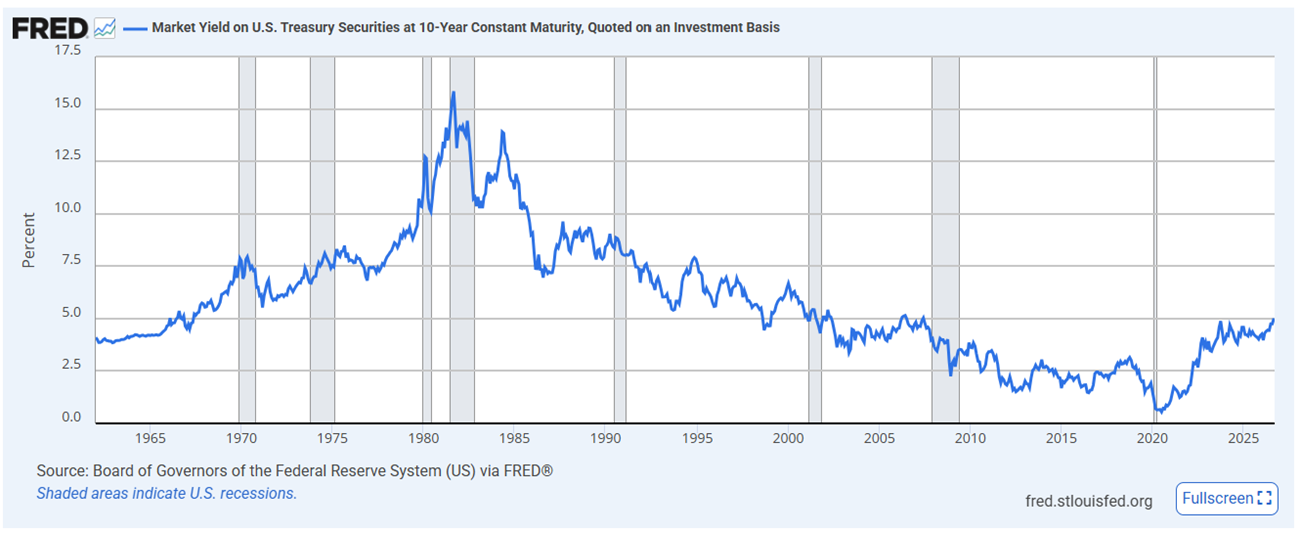
Historical yield on 10-year U.S. Treasury securities. Source: Board of Governors of the Federal Reserve System, via FRED.¹³
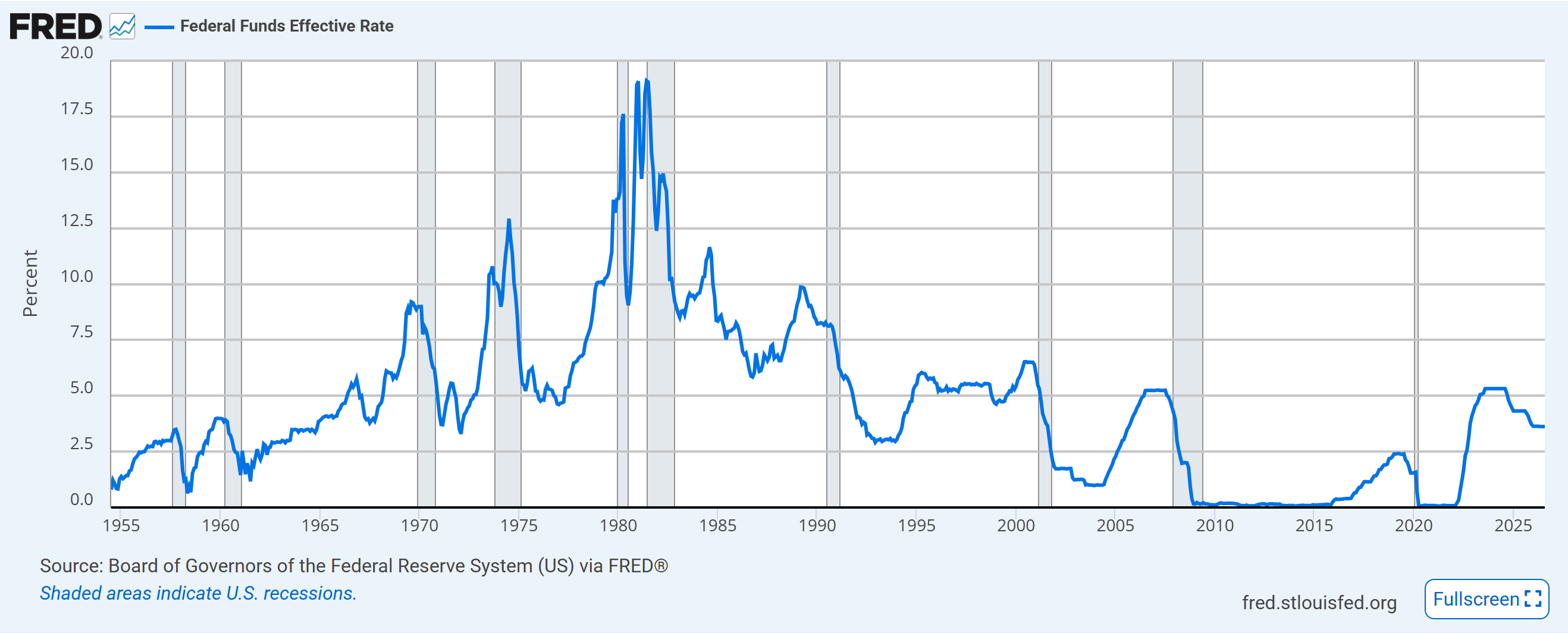
Historical federal funds effective rate. Source: Board of Governors of the Federal Reserve System, via FRED.¹⁴
In 2007, interest rates began dropping as the world entered the Great Recession. That marked the beginning of an extended period that included years of unusually low rates. For much of that time, debt was cheap and financing was easier to obtain.
Before that period, rates were often much higher. Sometimes much, much higher.
In recent years, Treasury yields and interest rates have risen again. There are still dips and swings, but it prompts the question: What if interest rates are really just getting back to normal? What if an ultra-low interest rate environment was a phase in history, like skinny jeans, arcades, or drive-in movie theaters?
If that’s true, and understand, this is a possibility, not a prediction, it would have ramifications for the stock market.
Companies and investors have both become used to low interest rates. If higher rates persist, they may have to be more careful with capital as financing, or the ability to pay it back, becomes harder than it used to be.
Would that have an effect on growth? Possibly. But we have to remember that the stock market is a recipe, too, one influenced by dozens of ingredients.
We do not know what the future holds. Treasury yields and interest rates could stay elevated; they could come back down. The markets could wobble; we could also learn that they are strong enough to lift a lot more weight.
What Do We Do With All This Information?
Given how important Treasury yields are to our financial system, we wanted to provide a comprehensive look at what’s going on and why it matters. But while more information can be useful, it’s not always clear what we should do with it.
To answer that, let’s return to our weight-lifting analogy one more time.
Imagine you have complete, unrestricted access to all the equipment in a gym. Every free weight, every machine.
It would be easy to get overly excited and start using everything willy-nilly, hoping to achieve the results you want in record time. Such an approach would probably be unsuccessful, and maybe even unsafe.
Or you might feel completely overwhelmed. You might stick to only one or two things, exercises you understand or already have experience with. Maybe you leave the gym altogether.
When we lift weights, we need to do it thoughtfully, carefully, systematically. Never lift more weight than we can handle. Work all the major muscle groups, don’t skip leg day, and pay attention to proper form. Avoid overtraining, but also be mindful of plateauing if we don’t push ourselves.
The more informed we are, the more we understand the what and the why behind every exercise, the better prepared we are to take that measured approach.
The same idea applies to investing.
We must be careful not to give our emotions free rein over our actions. We must avoid overreacting to scary-sounding headlines, whether they’re about bond yields, oil, inflation, or anything else. At the same time, we must be mindful about getting overly exuberant about AI, the stock market, you name it.
Understanding the why behind the headlines can help us avoid overreacting to them. Being aware of the risks and challenges of a higher-interest-rate environment can help us prepare for them.
That’s what we do with all this information. We use it as a compass, or a leveler; as a gimbal or a wedge. Something to keep us steady, balanced, and on-course.
This is an interesting period to be an investor, because there are so many ingredients to weigh and sort; so many storylines to study and ponder. While that can create uncertainty, it can also create opportunity.
That’s why we remain optimistic about our clients’ long-term goals and the investment strategy we’ve put in place to help them work toward those goals.
As always, we will keep you updated on what’s going on in the markets. In the meantime, please let us know if you have any questions or concerns. We are always here for you!
Sources
1 “Market Yield on U.S. Treasury Securities at 10-Year Constant Maturity,” Federal Reserve Bank of St. Louis, https://fred.stlouisfed.org/series/dgs10
2 “Remarks by Secretary of the Treasury Scott Bessent before the Treasury Market Conference,” U.S. Department of the Treasury, https://home.treasury.gov/news/press-releases/sb0314
3 “Who’s buying U.S. Treasury debt, and why?” Brookings, https://www.brookings.edu/articles/whos-buying-u-s-treasury-debt-and-why/
4 “Know your bonds: A quick guide to Treasuries,” CNN Business, https://www.cnn.com/2026/09/10/economy/bond-market-treasury-explained
5 “U.S. diesel prices soar past $6 a gallon,” Associated Press, https://apnews.com/article/diesel-prices-record-iran-war-636252b3b82326b41661ee5c4073dacb
6 “Ever Wonder What Percentage of Americans Are in Debt?” National Debt Relief, https://www.nationaldebtrelief.com/blog/financial-wellness/credit-score/ever-wonder-what-percentage-of-americans-are-in-debt/
7 “The Demographics of Household Debt in America,” Debt.org, https://www.debt.org/faqs/americans-in-debt/demographics/
8 “What is the national debt?” U.S. Department of the Treasury, https://fiscaldata.treasury.gov/americas-finance-guide/national-debt/
9 “GDP and Corporate Profits, 2nd Quarter 2026,” Bureau of Economic Analysis, https://www.bea.gov/news/2026/gdp-second-estimate-and-corporate-profits-2nd-quarter-2026
10 “Economy at a Glance – Unemployment Rate,” Board of Governors of the Federal Reserve System, https://www.federalreserve.gov/economy-at-a-glance-unemployment-rate.htm
11 “Federal Reserve issues FOMC statement,” Board of Governors of the Federal Reserve System, https://www.federalreserve.gov/newsevents/pressreleases/monetary20260916a.htm
12 “The AI buildout rests on hidden debt,” GIS, https://www.gisreportsonline.com/r/ai-buildout-hidden-debt/
13 “Market Yield on U.S. Treasury Securities at 10-Year Constant Maturity,” Federal Reserve Bank of St. Louis, (Max View), https://fred.stlouisfed.org/series/dgs10
14 “Federal Funds Effective Rate,” Federal Reserve Bank of St. Louis, (Max View), https://fred.stlouisfed.org/series/fedfunds
15 Understanding Bond Yield and Return (FINRA), https://www.finra.org/investors/insights/bond-yield-return?
Disclosure
The opinions expressed in this piece are for general informational purposes only and are not intended to provide specific advice or recommendations for any individual or on any specific security. It is only intended to provide education about the financial industry and the economy. To determine which investments may be appropriate for you, consult your financial advisor prior to investing. Any past performances discussed in this letter are no guarantee of future results. As always please remember investing involves risk and possible loss of principal capital; please seek advice from a licensed professional.
Advisory services are offered through Entruity Wealth, LLC, a Registered Investment Adviser. Services are only offered to clients or prospective clients where Entruity Wealth, LLC and its representatives are properly licensed or exempt from licensure. Past performance is no guarantee of future returns. Investing involves risk and possible loss of principal capital. No advice may be rendered by Entruity Wealth, LLC unless a client service agreement is in place.
Certain Advisory Persons of Entruity Wealth are also registered representatives of Purshe Kaplan Sterling Investments, Inc. Securities offered through Purshe Kaplan Sterling Investments, Member FINRA/SIPC Headquartered at 80 State Street, Albany, NY 12207. Purshe Kaplan Sterling Investments and Entruity Wealth, LLC are not affiliated companies. California Insurance Producer License Numbers 0A68692 and 0K53827.